ABGi continues its support of Mélina Robert-Michon

Heavy-duty transportation: the electric revolution is underway
By Capucine Lalliard, Science Editor, ABGi France
By Capucine Lalliard, Science Editor, ABGi France
Road freight transport is a key issue in France’s climate transition. Heavily reliant on diesel, this sector is responsible for approximately 27 MtCO₂e per year, or nearly 7.4% of national emissions. More broadly, transportation is one of the highest-emitting sectors and the one requiring the greatest reduction efforts by 2050.
The National Low-Carbon Strategy (SNBC) aims to reduce freight transport emissions by about one-third by 2030 and achieve carbon neutrality by 2050. To achieve this, several levers must be mobilized jointly. Carbione 4 highlights a systemic approach, based on reducing transport demand, optimizing flows (particularly load factors), shifting to lower-emission modes of transport, improving energy efficiency, and decarbonizing the energy used.
In this context, the electrification of heavy-duty trucks plays a decisive role. As illustrated in Figure 1, it accounts for more than 50% of the effort to reduce emissions between 2023 and 2050, and nearly 70% after 2030. This priority stems from its high decarbonization potential: electric trucks reduce emissions by approximately 80% over their entire lifecycle compared to diesel. Conversely, other alternatives have limitations: biofuels are constrained by resource availability, natural gas remains a fossil fuel, and hydrogen, while promising, is still costly and not yet mature (Figure 2).
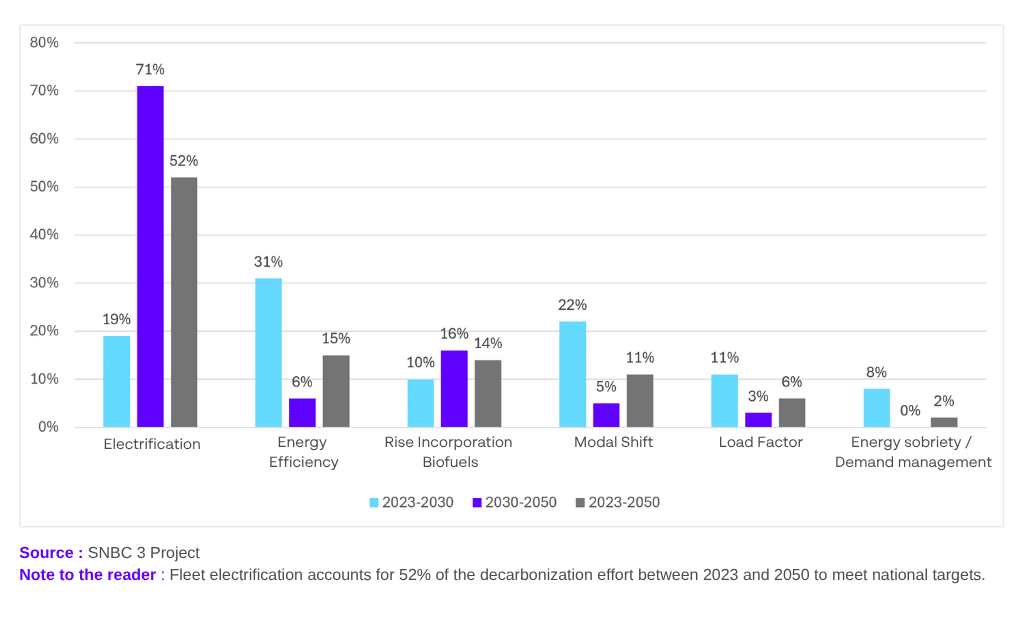
Figure 1: Estimated contribution of various measures to the decarbonization of heavy-duty vehicles according to the SNBC 3 draft, by period. Reproduced from Duval, M. Les poids lourds : en route vers l’électrification.
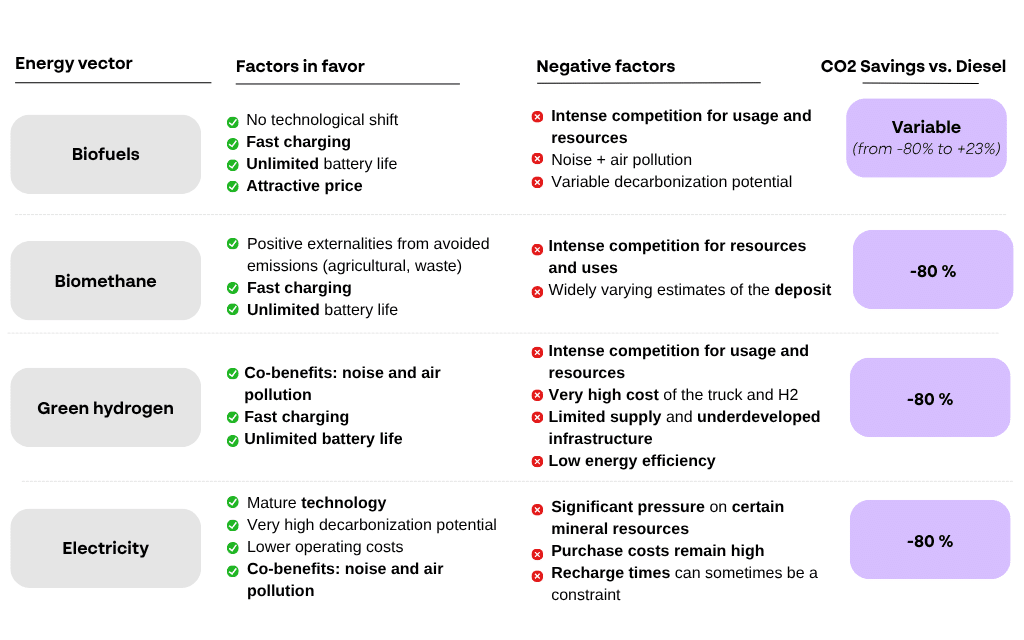
Figure 2: Summary of the advantages and disadvantages of alternative engine types to diesel. Reproduced from Transport routier de marchandises, comment éviter le dérapage énergétique ? Mixenn.
Despite these advantages, the market is still at an early stage. In 2025, electric heavy-duty trucks remained a very small segment, accounting for approximately 2% of new registrations—or 865 vehicles out of a total of 43,300—while the fleet in operation remained limited to 1,369 units out of more than 565,000 heavy-duty trucks. This situation is due in particular to high purchase costs, which are still two to three times higher than those of diesel vehicles, as well as to constraints related to charging infrastructure and logistics.
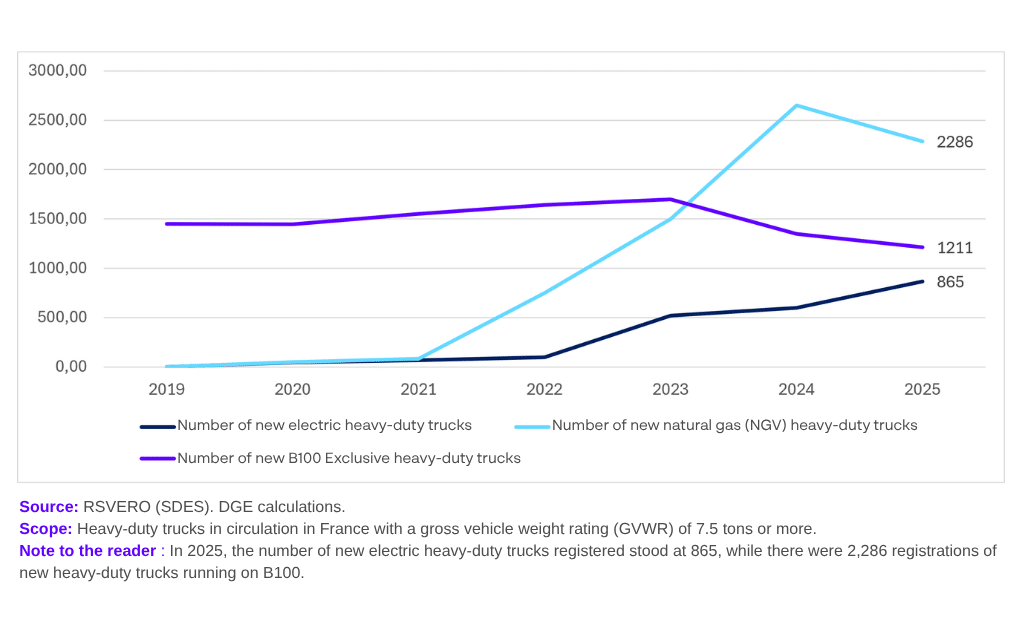
Figure 3: Number of new heavy-duty truck registrations by powertrain. Reproduced from Duval M. Les poids lourds : en route vers l’électrification.
Nevertheless, feedback indicates that this technology is already in use, including on certain long-distance routes, with ranges of 300 to 450 km. Electrification therefore appears to be an essential solution, and its deployment must be accelerated in order to meet climate goals.
Innovation in road transport today revolves around several major transformations—technological, organizational, and economic. The first key area is undoubtedly the electrification of heavy-duty trucks, considered the primary driver of long-term decarbonization. This transition relies on continuous improvements in battery performance (range, cost, durability) as well as the deployment of suitable charging infrastructure, particularly at depots and along major routes. Analyses consistently show that this technology is the most mature and effective for reducing emissions, with a reduction potential of up to approximately 80% compared to diesel over the life cycle. By 2030, the expected decline in costs should enable electric vehicles to become economically competitive with internal combustion engines, marking a decisive turning point for the sector.
A second area of innovation concerns the optimization of logistics flows and operational models. The integration of digital tools, artificial intelligence solutions, and advanced planning enables the reduction of empty runs, improved load factors, and streamlined routes. According to some estimates, a significant portion of trips could be optimized, generating both economic and environmental benefits. Electrification itself is driving this transformation by encouraging stakeholders to rethink route planning and fleet management.
Furthermore, the evolution of business models constitutes a third key area. The development of new forms of cooperation between shippers, carriers, and public actors, as well as the implementation of innovative financing mechanisms, appear essential for absorbing transition costs. The integration of carbon costs into logistics decisions and the transformation of value chains are at the heart of these changes.
Finally, other complementary innovations are emerging, notably the development of alternative propulsion systems (hydrogen in the longer term), the modal shift toward rail or inland waterways, and the adaptation of infrastructure to climate challenges. However, these solutions remain limited either by their technological maturity or by resource or competitiveness constraints.
In the future, the sector should therefore evolve toward a more low-carbon, digitalized, and integrated model, combining technological innovations with changes in practices. The challenge will be to accelerate these dynamics to align the pace of transition with national and European climate goals.
The first incentive is the research tax credit (CIR), which aims to encourage companies to undertake research and development (R&D) activities. The activities covered by the research tax credit are systematic efforts based on knowledge derived from basic and applied research. Their objective is to lead to new products or processes or to improve existing ones.
The Innovation Tax Credit (CII) is an extension of the Research Tax Credit (CIR) that applies to expenses incurred by SMEs through December 31, 2027. The eligible expenses relate to the design of prototypes or pilot facilities for a new product, provided two conditions are met: the first is that the product must not yet be available on the market, and the second is that it must stand out from existing products due to its superior performance in terms of technical specifications, eco-design, ergonomics, or functionality.
At the same time, several French calls for projects are currently driving innovation and R&D in the mobility sector, particularly to support the decarbonization of heavy-duty mobility.
– The CORAM 2026 is the central component of this strategy. It supports innovations related to zero-emission vehicles, electric powertrains, and connected mobility solutions. Open until December 15, 2026, the goal is to foster the development of breakthrough technologies while supporting their transition to industrial scale.
– In addition, INVEST AUTO aims to strengthen French industrial sovereignty by supporting the production of electrified vehicles and their essential components. It also covers technologies related to charging systems and the electrification of powertrains. It is open until October 20, 2026.
– Finally, the Hydrogen Innovation and Demonstration call for projects supports research and development as well as industrial demonstrators in the field of hydrogen applied to transportation. It specifically concerns innovative vehicles and energy systems associated with heavy-duty mobility. Although this technology is still maturing, it represents a complementary alternative to battery electrification for certain specific uses, particularly over long distances. This call is open until September 25, 2026, with several interim rounds.
Finally, among the many national funding programs in Europe supporting hundreds of projects, here are a few examples that can be applied for in 2026 in the transport and mobility sector:
– The HORIZON-CL5-2026-10 – BATTERIES and MOBILITY aims to combat climate change by improving understanding of its causes, evolution, risks, impacts, and opportunities, and by making the energy and transport sectors more climate- and environment-friendly, more efficient and competitive, smarter, safer, and more resilient.
– The EIT Urban Mobility is a community of 325 partners from all sectors related to urban mobility, including the New European Bauhaus and the Regional Innovation Scheme (RIS). Proposed projects must align with the EIT’s three pillars: Innovation, Business Creation, and Academy, and will be led by consortia comprising at least two entities from European Union member states or countries associated with Horizon Europe.
So, please feel free to check the official websites regularly and reach out to us for an initial consultation before seeking specialized support to maximize your chances.
Feedback from XPO Logistics, Jacky Perrenot, CEVA Logistics (ECTN project), and Dania Connect shows that the electrification of long-distance road transport is now an operational reality, albeit still challenging. Despite varied contexts—regional, national, and international routes; charging at the depot or exclusively at public stations; dedicated or shared logistics—several key lessons are emerging.
The electric trucks deployed cover distances ranging from 400 to nearly 3,000 km round-trip, with actual ranges often exceeding initial expectations. In all four cases, the quality of logistics service is maintained, including for complex or cross-border flows. After an initial adjustment period, drivers have provided unanimously positive feedback, highlighting driving comfort, reduced noise and vibrations, as well as a more engaging driving experience thanks to eco-driving and energy regeneration.
At XPO Logistics and Jacky Perrenot, the introduction of electric trucks has led to a rethinking of planning, battery sizing, and route organization. The ECTN project goes further by proposing an organizational breakthrough: route segmentation, trailer swapping, and the seamless integration of charging times into drivers’ breaks. This approach enables the over-optimization of vehicles and infrastructure, with structural cost savings in the medium term.
When charging is largely internalized and supported by public subsidies, costs can approach parity with diesel (XPO, Jacky Perrenot). Conversely, heavy reliance on public charging, particularly on very long-distance routes (Dania Connect), still results in significant additional costs. The cost and predictability of electricity thus emerge as key determining factors.
Finally, all cases highlight the central role of the ecosystem. The involvement of charging operators through multi-year commitments, the availability of reliable infrastructure, appropriate planning tools, and a stable regulatory framework are identified as essential conditions for scaling up. Together, these four examples confirm that the transition is possible, but that it relies above all on close coordination among stakeholders and a profound transformation of operational models.
Duval M. Heavy-duty trucks: on the road to electrification.
Electric heavy-duty trucks: crossing the operational threshold [Internet]. Available at: https://www.carbone4.com/publication-poids-lourd-electrique
[Webinar] Road freight transport: how to avoid an energy backslide? Mixenn [Internet]. Available at: https://mixenn.bzh/agenda/webinaire-transport-routier-de-marchandises-comment-eviter-le-derapage-energetique/
T&E France [Internet]. 2026. Electric heavy-duty trucks: how to make it work. Available at: https://www.transportenvironment.org/te-france/articles/poids-lourds-electriques-comment-transformer-lessai


ABGi continues its support of Mélina Robert-Michon
Aussi

